


I am a Science Fiction fan. Not the alien and lasers type of fan, but stories that might come true. The bases of the story need to be true science, applied in a scenario with some imaginary assumptions. Great examples are books of Michael Crichton (Jurassic Parc, Prey), Dark Matter and Recursion (Blake Crouch), Seveneves(by Neal Stephenson) or Limit (Frank Schätzing). And many many more (check my Goodreads or Storygraph profile) If you combine that with a stage in a dystopian world, you have me hooked! I like the darkness, the heroism, and in many cases, the revolution that starts to reinstate the world we, as readers, once knew.
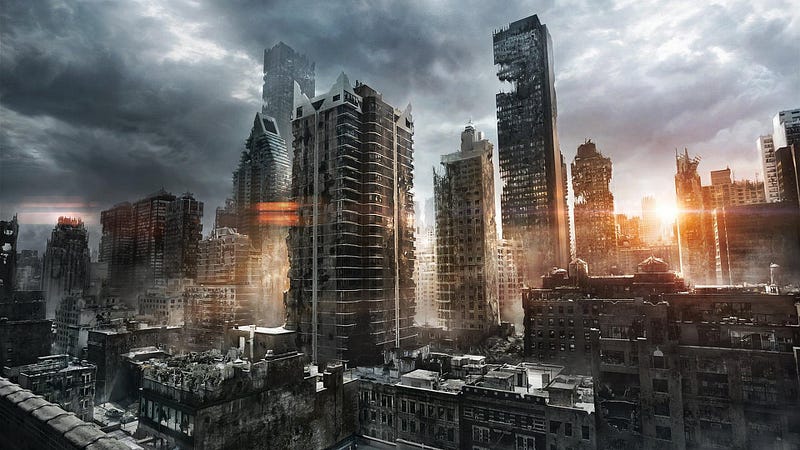
Dystopian World (Source: https://wallpapercave.com/w/wp2015896)
I write this post because with everything that is going on right now in the world, I feel that we are in the prologue of a new to be written book. This started in the COVID-19 time. The “mind-numbing Work From Home”, or the”COVID-19 follow the rules”, and now evolves in to the worldwide chaos of war and extreme right politics. And writing some of this down.. well it helps me to let go :-). In these series I want to talk about a book I read, and talk about some similarities I see (or saw) in our present world. Let me share some of my, hopefully non-rational, thoughts and let’s see if you some similarities too.
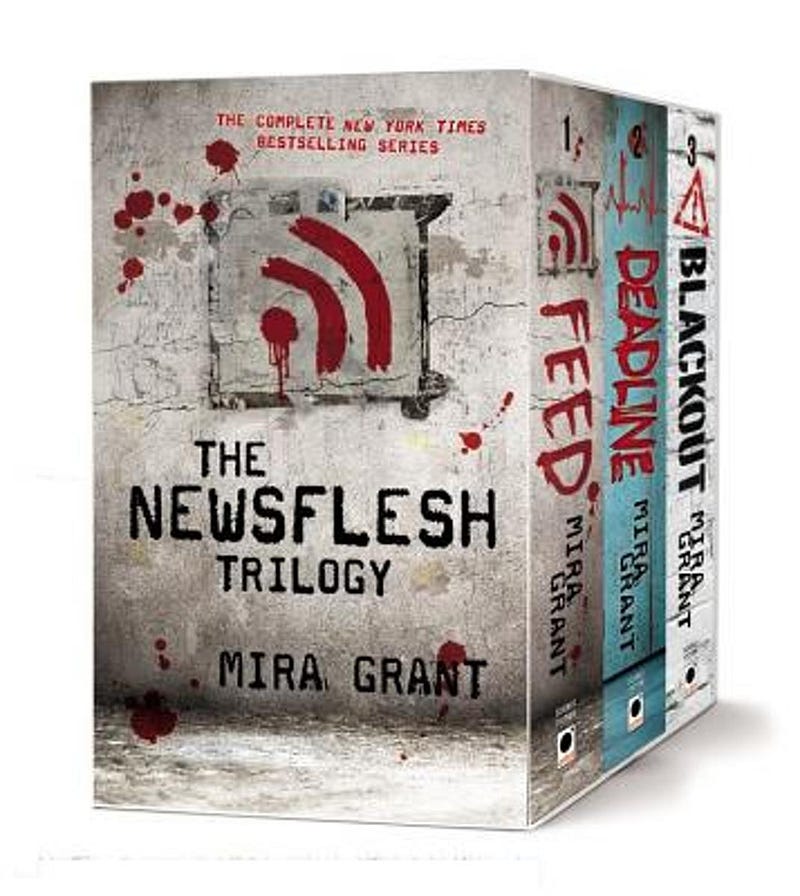
Newsflesh Trilogy by Mira Grant
Today I want to talk about the Newsflesh Trilogy by Mira Grant.
Yes, it’s a zombie story, but don’t scroll away just yet. I know zombies might feel a bit overdone, but this series is different. It’s not just about the undead wandering the streets, it’s about how they got there in the first place. And that story is scarily plausible.
It all starts with two medical breakthroughs. One is a vaccine for the common flu, developed by Dr. Alexander Kellis. To make sure everyone gets protected, the vaccine is designed to be airborne. Around the same time, Amanda Amberlee develops a potential cure for cancer. Both treatments are still in early testing, but things escalate quickly. Political pressure and a rogue activist group lead to the premature release of the vaccine, supposedly for the greater good. Since it spreads through the air, there’s no stopping it. The unintended result of the two treatments interacting is the Kellis-Amberlee virus, a condition that turns people into zombies.
In this new world, traditional media no longer tells the whole truth. That’s where the bloggers come in. A tight-knit group of citizen journalists, armed with blogs, cameras, and courage, sets out to uncover what really happened. They call themselves “Newsies,” and their mission is clear: get to the truth, no matter the risk.
A look at today
Some of the themes in the series hit surprisingly close to home.
- Media trust and truth. In the books, traditional news is filtered, biased, or outright false. The public turns to bloggers for the unfiltered version. We’re seeing something similar today. Between traditional outlets, influencers, and viral content, it’s harder than ever to know what’s real. And with algorithms feeding us what we want to hear, we rarely get the full picture.
- Echo chambers and bias. Newsfeeds, cookies, and social media preferences narrow what we see. Unless we actively seek out other perspectives, we end up with a one-sided view. In Newsflesh, the bloggers are boots on the ground, sharing unfiltered footage and first-hand accounts. It reminds me of how today’s livestreams and social posts often provide a raw look at events before the official narrative sets in.
This is just one book I recently revisited, but the parallels stuck with me. It made me think about other books that echo parts of our current world in unexpected ways. So in my next post, I’ll dive into another one.
If you’ve read Newsflesh, or have a book suggestion with similar themes, I’d love to hear from you. Drop your thoughts in the comments, constructive ones please.

 The Road to ALM